Top bar page nav

Saturday, November 19, 2016

Reflection on Let Girls Learn in my community


Rosana Zarza-Canova serves as a Peace Corps Youth Development volunteer in a town near Marrakesh. She grew up between the Berkshires, Massachusetts and Madrid, Spain. In her last months of service she is focusing on establishing a community library with the Director of the youth center and Library club at the youth center and work with girls, co-facilitating the Life skills program at the girl's dormitory with a counselor and helping start a girl's club at a youth vocational center. She also enjoys spending time with friends and neighbors and mastering traditional Moroccan foods!
 Read more at: rosanacouscous

Reflection on Let Girls Learn in my community


Rosana, pictured right, at a English certificate party at the youth center she works at

*I have changed the names of my friends to protect their privacy.

First Lady Michelle Obama’s visit to Morocco and Marrakesh made me reflect deeply on the struggles of girls in my community to achieve an education. When I look back upon my year’s work at the dar shabab (youth center), the majority of those who have benefited from my classes, activities, and events are boys or young men. This makes me wonder why there is not equal participation among boys and girls. The program Let Girls Learn renewed my interest and commitment to work with girls during my last couple of months as a Peace Corps Volunteer in Morocco. In this post, I will describe obstacles that girls in my town face and highlight them with a stories.

My community is a small, conservative town of 5,000 near Marrakesh. There is one elementary school, one middle school, and one high school. Around my site are 15 duars (farming villages), which only have elementary schools. There are often one or two teachers for grades 1-6 in a one-room schoolhouse with limited resources. If the girls in the duars want to attend middle school or high school, they have to travel into town. It is common for girls to drop out because their parents don’t want them to travel in addition to not being as prepared in their schoolwork because of the education they received in elementary school. The school provides transportation or for a small fee they can apply to live at the dar taliba (girls’ dormitory) during the school week.
When I say that my town is conservative it is because gender roles are traditional. Most girls aspire to get married and have children as early as 17 or 18 years old. Men are the breadwinners. In comparison to my liberal upbringing, this is a conservative outlook.

Housework
The first obstacle that prevents girls from staying in school is housework. Girls are expected to help around the house. They have many responsibilities like cooking, cleaning, and taking care of siblings, all which gives them less time to do their homework and study for quizzes, semester tests, and final exams, or going to the dar shebab. When I asked my students if they wanted to continue English classes during Ramadan, the boys said yes and the girls no. The girls explained that they were needed to help prepare the evening meal to break the fast. During the last Ramadan, I didn’t see any girls in the dar shebab for this reason.

Fatima Zahara’s story
Fatima Zahara is 15 years old and in the 9th grade. When her mother went away for a week to visit her sick father, Fatima Zahara did all the housework. One day I stopped by her house after work and found her kneeling in the kitchen, putting bread into the oven. She had on a scarf to keep her hair out of her face and was in her pajamas; she looked like any other housewife. We later devoured a delicious fish tagine she had made, and I complemented her on her expert cooking.
I mentioned my surprise that she did all the housework and explained that for me it was normal that my parents take turns cooking. They laughed when I mentioned that my Papá takes pleasure in cooking his famous seafood paella for me. Fatima Zahara and her family said that in Morocco a girl is expected to learn how to cook and clean in preparation for married life. There is word for a good housewife in Moroccan colloquial, Darija: hedga. So a girl must be hedga before she gets married. 
Around this time, Fatima Zahara dropped out of school, but she hid it from me. However, I learned that it wasn’t because she was busy with housework. Her parents, Nadia and Mohamed, cornered me one day and pleaded with me to find out what happened so that Fatima Zahara would return to school. They said they had tried everything- they had talked to her teachers and the principal, talked to Fatima Zahara, even told her that she needed to go to school, work, or get married (though they thought she was too young to get married). They revealed that they had not finished primary school, but they wanted Fatima Zahara to at least get a Baccalaureate degree (high school diploma). Nadia told me about the literacy classes she had attended at the mosque a few years ago, and taking out her cellphone, she proudly showed me how she could use her Arabic it in.
After that, I tried to find a time to talk with Fatima Zahara alone and find out what had occurred. I was concerned that she thought I would disapprove of her decision to drop out, but with luck she might open up to me. When we finally spoke, she confessed that she had had a problem with a teacher. She had raised her hand to point out something wrong in the lesson and this wasn’t received well by the teacher. He apparently mentioned this to other teachers, and Fatima Zahara started feeling uncomfortable at school. She spoke with the school principal, but she said it didn’t help.
I thanked her for sharing this, and advised her to apologize to the teacher and principal, forget about the past, and do her best on her final exams. I placed the emphasis on the value of high school to teach basic knowledge and skills for life and provide better opportunities for her future. With a high school diploma, she could attend vocational school or university, which would then qualify her for higher paying jobs.
I also wondered what Fatima Zahara did when she was not in school. She said she did “walo” (nothing), watched TV, cooked and cleaned, and later she got a job packing vegetables in a nearby factory. I asked her if she got bored doing walo because her friends were in school or studying. Fatima Zahara replied she did miss being with her friends, and (relief!) she planned to return to school in September. She’ll have to repeat 9th grade but she didn’t mind. I offered to help with schoolwork or to put her in contact with someone that could provide tutoring.

Different expectations
I also find that parents don’t have high expectations for their girls’ education. Perhaps they can’t imagine anything beyond their own experience or maybe they are pessimistic about the general economic situation. Even if their daughters attend high school, parents consider that education for a housewife is not necessary. I challenge that point of view because many of their daily tasks depend on being able to read, write and do math. For example, when they go to the hanut (corner store) they need to read food labels or read instructions on how to use household items. Medicines, too, require reading! When they pay at the hanut or the weekly souk (market), they need to know how to add and subtract, especially if they are quoted the price in Riyals but are paying in Dirhams. Housewives need to be able to calculate household expenses per day and week based on the family income. Unfortunately, I’ve observed that the majority of women don’t actually go to the hanut or souk in my community; they depend on their husbands or sons to shop.
Women’s space is comfortably in the home. Some of the important tasks that women have in the home besides cooking and cleaning are caring for children, being a role model, carrying out family traditions and upholding the family’s status in the community.

Financial problems and Khadija’s story
Some young women face financial difficulties and must help out their families instead of completing their education. Because boys are expected to be the breadwinners, their education is prioritized over the girls who are expected to be the housewives. Such is the case of Khadija. She is 31 years old and works at the preschool in her duar and volunteers at the association for the girls’ dormitory in town. She didn’t graduate high school and her studies at a vocational school were interrupted when her father got sick. She started working at age 19 to support her family of 7 (both of her sisters were married at a young age). She wishes that she could have continued studying, but there really was no choice. I find it admirable that she took on all that responsibility, placing her family’s needs before her own.
As a working woman and unmarried at age 31, Khadija is an anomaly in my village. She is the breadwinner of her family. She gives her father money to buy food at the weekly souk, her mother to buy household items or clothes, and she makes the big financial decisions for the family, like buying a new TV or cupboard or organizing an excursion into Marrakesh to visit family.
Khadija would love to get married and have a family, but her responsibility to provide for her family weighs on her. She claims that men don’t like working, independent women. Men believe that a woman’s place is in the home. They might also be jealous of other men at their wives’ work place, and husbands generally don’t want to see their women interacting with men that are not in their family. If Khadija gets married, she would have to continue supporting her family or her husband would need to take on that responsibility. Khadija and other friends have asked me to set them up with an American or Spanish friend because they believe Western men are more open than Moroccan men. They say Western men would allow them to wear what they want, come and go as they please, work, and allow some degree of independence.
There is also the notion that if a woman works, she doesn’t have a good husband. She is called meskina (poor thing). The man is supposed to work and take care of her. She can just relax at home.

Role models
Role models of educated or working women are hard to find; a girl’s goal is to settle down and start a household. Like teenage girls in any country, I often find girls heads filled with boys and not about their studies or learning a new skill, working, traveling, or starting a business. They talk about crushes and boyfriends and ask when I plan on marrying and having children. I’m another anomaly now as a young woman who has made the choice to focus on work, live far away from my home, share responsibilities in my future marriage, and lead a different lifestyle.

Miriem’s story
19 year old Miriem is in her first year of studying economics at Cadi Ayyad University. Once I went to her house, and she was having a panic attack before her final exams. She had all her notes scattered around her room and was moaning, “Rosana, I hate economics!” “I don’t understand French.” Many subjects at the universities in Morocco, like biology or chemistry, are taught in French, based on the education system inherited from French colonial rule.
Then, Miriem confessed she was seriously considering a marriage proposal because she was having a terrible time with her studies. She had received a marriage proposal from a friend of her father’s with the one condition that she had to wear the niqab (headscarf with face covering). I encouraged her to continue on with her studies, to ask the professors for help, attend office hours, seek out fellow students, anything to work hard at completing her studies. We made a list of pros and cons for getting married versus finishing university. Why not finish university and then get married? Why not do both? Like the high school education for Fatima Zahara, a university education for Miriem would provide more job opportunities at a higher pay scale. Her English is pretty good, too, and that would be an asset in any job. Alternately, she could change her major to English. 
Thus, girls in my community face many obstacles to finishing their education. I realize that I have had a very different upbringing, which has made me embrace different values. I grew up in a liberal, middle class college town. I had few household chores like cleaning my room, emptying the dishwasher, and setting the table. It was expected that I graduate high school with good grades and go to university. I got a tutor when I struggled in Geometry and attended many extracurricular activities. When my friends and I still hadn’t learned how to drive, our parents would drop us off and pick us up from the movies if we wanted to go. We would walk into town for lunch or dinner and meet up with boys. When we learned how to drive, we would cruise around town at night. I had many university educated, working, independent, strong female role models and single and divorced mothers who were seen as equals and well respected in the community. I saw men helping out around the house and cooking up delicious meals. Relationships and marriage are different in the West. I will be able to date and choose my husband. For all these reasons, I find traditional gender roles in Morocco hard to understand and limiting. I do know that in the West there are traditional roles, too, but they are changing, especially for my generation. But, I have to admit that during my Political Science studies at college, I didn’t find many female role models in politics.
I believe I am, just by being here, a role model for girls and young women. I am university educated, am working, and am unmarried, not even engaged! I live alone and travel on my own in Morocco, and I’m independent. This difference is accepted though it might not be a choice for them. I’ve shared my background and life goals with them and in this exchange created friendships with a space to think differently.
In my work here I will continue to be a friend and a mentor to the girls, advising them as best as I can when asked and emphasizing the importance of education. I will continue to encourage them to develop their interests and gain experience for their future. This recognition of their own potential will open up new awareness and possibly new opportunities.
----
Posted by Shawn Dubberly 

Friday, November 4, 2016

Girls Basketball Camp

by Ben Zapchenk

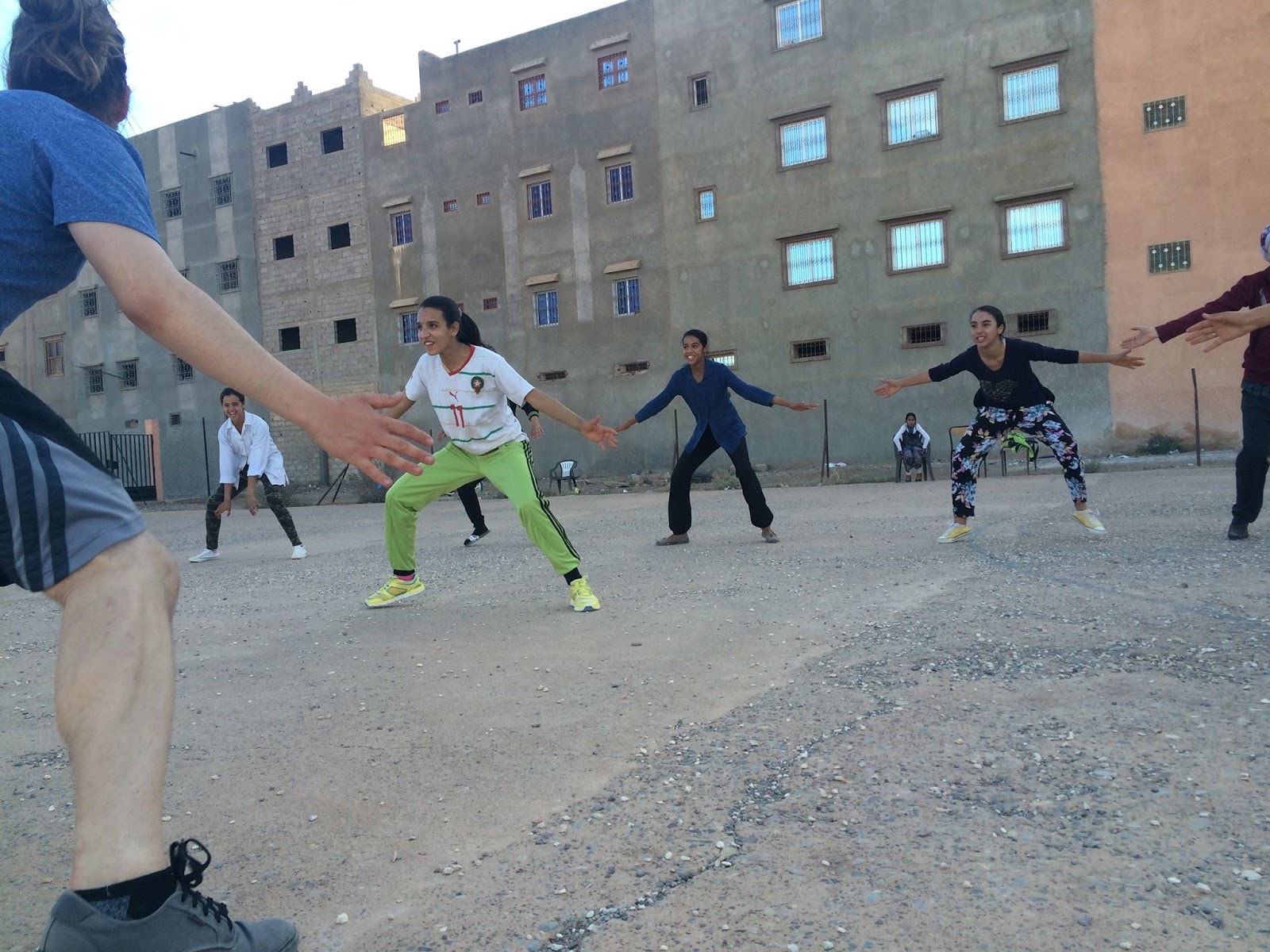
The idea for the girls basketball camp in Agdz started one day this past spring, when there was a week long break from school and many students were growing restless with the lack of extracurricular activities for them to participate in. After a few conversations with some female students in Agdz, I noticed that all of them were interested in participating in physical activities that would afford them an opportunity and a reason to get out of their houses. Due to the existing cultural structures in Moroccan society, many girls and women are hard pressed to find communal spaces where they can be themselves and engage in collective endeavors, whereas boys and men find no such restrictions.

To get the ball rolling on this camp idea, I spoke with the director of my Dar Chebab and my primary counterpart about the strong interest on behalf of the local students. Once we hammered out the schedule, times, and location for the camp, the rest of the planning (minus the traditional certificate ceremony, food, end of camp celebration) was on me. The camp ran for three days, two hours a day, over the course of the week long school break. Each day we began with basic drills and activities for learning the fundamentals of the game: dribbling, passing, shooting, defense. The last thirty minutes to an hour of the day were reserved for organized team activities, which primarily consisted of breaking the camp participants into two teams and holding scrimmages between them. By the conclusion of this camp, the twenty girls who had participated were unified in their desire to continue learning the game and turning this camp into a weekly club.
Basic drills to learn the fundamentals of dribbling, passing, shooting, defense
Once again, I went back to the Dar Chebab director and my counterpart in order to present my idea and initiate a meeting with everyone that would be involved. After holding a few meetings with the students and parents to introduce the basketball club idea and to inform the parents as to the benefits of participation in this club, we were ready. For about four months on Tuesdays, Thursdays, and Saturdays, from the spring up until the advent of Ramadan, I would meet with a group of 20-30 girls ranging in age from 4-17 in order to teach them the game of basketball. 
We started with the basics: what the lines on the basketball court mean, how to dribble and pass, and proper shooting form. The typical structure for each club meeting would be as follows: thirty minutes to an hour of basketball drills and games designed to acclimate students to the game, followed by thirty minutes to an hour of organized scrimmages where the kids could apply those skills and enjoy the organized chaos that comes with learning how to work, play, and communicate with one another. After several weeks there was noticeable skill improvement in those who were consistently attending.


End of camp celebration
There is one specific memory from the club that will be inexorably imprinted upon me. We were working in a mixed group of boys and girls, with half consisting of high school girls and the other half consisting of elementary school boys and girls. After going through drills as a collective unit, I split the younger boys and girls into two teams for a scrimmage. After the scrimmage began it quickly became apparent that these young ones needed more instruction about the rules of the game and the basics of dribbling, passing, etc. Before I had a chance to intervene, two of my older girls, Saida and Samira, stopped the game and had the youngsters form a circle in center. For the next 40 minutes Saida and Samira taught the youngsters the do's and don'ts of basketball: how to dribble with the tips of your fingers, why you can't dribble the basketball with two hands, how to make a chest pass, where the out of bounds line is and what it means, and so on. It was a beautiful moment that made me feel happy for them and the ownership that they were able to take in their basketball club. 

Girls taking ownership in their club

--

Posted by Shawn Dubberly


Wednesday, October 26, 2016

Success Stories: Gender work at all speeds

by Shawn Dubberly

This Gender and Development (GAD) Committee recently presented at the Meknes HUB. They introduced GAD to the new staj and used exercise as a theme to illustrate various speeds of gender work. Here are some the success stories from the last two years.

Gender and Development Success Stories 

Walking, Jogging, Running
“Gender work at all speeds”

Walking


A Male in a Female Space
Steven Howard in Goulmima

Steven and his counterpart Mustapha chose to emphasize "International Girls' Day" at their Leadership Class at the Dar Chebab. They talked about some of the students' impressions of the place of girls in Moroccan society and what their perceptions were of girls' abilities to excel in society to the same extent as boys. Together, Mustapha and Steven, two men, encouraged all of the students to identify some negative stereotypes they have held about the ability of girls and women to achieve in school and work and recognize gender equality.

Celebrating Female Teachers
Shawn Dubberly Site: Birkouat
 
Shawn and a science teacher in site
At a school science fair, Shawn was pulled into a spontaneous speech. So she decided to focus her speech on celebrating the female science teachers. She told the students that they were lucky to have this intelligent role model in their lives. Then she included the students by telling them the importance of women in Science, Technology, Engineering and Mathematics (STEM). It’s rare for women to talk about themselves, so she felt this was a good example of how everyday gender work can simply be highlighting, celebrating and thanking women for the work they do.

Jogging


Women’s Hours at Men’s Gym
Rachel Gates-Vickery in Itzer
Women and girls gathering in gym 
Rachel works with a women’s athletics association. The women have an open space with homemade weights and a certified trainer however there is minimal resources/space that the association can provide. After months and months of trying, the women successfully got permission to integrate the services into the all male gym at the other end of town.
The previously all male gym is better equipped with materials as well as a shower. Increasing the instructor’s cliental led to a slight raise in income allowing her to build a shower in her all women’s gym and hopefully purchase new materials.
The women’s gym has not only been a space to workout, but they are the only true spaces in town dedicated to women. Women, now on both ends of town, can gather, workout, share recipes, talk about their kids, exchange prayer...really the opportunities are endless....it has created a bond that truly cannot be found anywhere else-not even in the streets where we know of women congregating.

GLOW Club
Rachelle Wilson in Sidi Rahal 
     

Rachelle wanted to find a way to start development work beyond language, reconciling that it may look much smaller than what she imagined. She meets once a month and do 3 to 4 hours of activities, some adapted from the GLOW camp curriculum. 

    
So far, our GLOW club has covered topics such as: education in Morocco, prioritizing, effective goal setting, self-advocacy, gender equality, and leadership.


Girl’s Basketball Club
Ben Zapchenk in Agdz


Ben noticed that girls were interested in participating in physical activities that would afford them an opportunity and reason to get outside of their houses. Because of the existing cultural structures in Moroccan society, many girls and women are hard pressed to find communal spaces where they can be themselves and engage in collective endeavors, whereas boys and men find no such restrictions.

Running


GLOW Safe Space Community Library
Julie Feng in Settat


The Girls Leading Our World (GLOW) Club of Settat is building a community library at the dar chebab. Our main goals:
                  ●  Access. Our community has no reasonable or affordable access to books.
                  ●  Capacity-Building & Empowerment. The library project is completely led by Moroccan girls and young women. Though this means that building is slower than most PC libraries, the power shift is worth it!
                  ●  Safe Community. Girls often get the message that they don’t belong in public domains, even at the youth center. The library creates a space that is completely inclusive.


GLOW Camp
Nina Lopez in Er-Rich

Nina worked on a 5 day GLOW camp with 35 girls. Covering subjects such as Healthy Lifestyles part I, Science, Healthy Lifestyles part II, Goal Setting & Careers, Agents of Change and The Environment.
Biggest Challenges: getting presenters to commit, girls waited until the last minute to sign up, Ministry backed out on providing lunch, keeping schedule on time.

Biggest Accomplishments: Given the opportunity counterparts really stepped up, participants brought food and supplies and we cooked together, not providing lunch was no big deal, Moroccans presented the majority of the classes, awesome toolkits available through Peace Corps.


Friday, June 24, 2016

2016 Gender Advocate Training in Fes!

Last month, the Gender and Development committee held its 2nd annual Gender Advocate Training in Fes. In attendance for the 2-day, bilingual conference were 15 Peace Corps volunteers and 17 Moroccan counterparts. Peace Corps Morocco volunteer Shawn Dubberly resides in Zaouia Ben Hmida and focuses her work on her community of girls at the boarding school (dar taliba) there. You can find out more about her service on her blog Bonjour Hello Salam. Shawn attended the training and shares her experience:


What is gender?

by Shawn Dubberly


That was the first question on the pre-training survey as we gathered in Fes for Gender Advocacy Training (GAT).  I had to admit it was a tough question. Everyone seemed to be confidently scribbling. I was afraid I would have to present my definition to a room full of obviously talented and experienced volunteers and their equally talented and accomplished Moroccan counterparts. Luckily, the first announcement that the facilitators, Brandy Blue, Noa Harris, Kika Kaui and Matt Hendrick made was to point out that the room was full of knowledge and the training would be an opportunity to learn from each other.

The training kicked off strong with a Safe Space Building activity. We created a guideline for behaviors that made us feel safe and also behaviors that made us feel uncomfortable.

Using the pre-survey question that gave me such a hard time, the facilitators opened up the training with a great gender awareness activity lead by Noa. Maybe you have done or seen a version of this, but I found doing the actual activity in a group very helpful. Seeing the activity play out showed me just how impactful and easy it could be in my site.

This was how it was structured:

 Each person was given a card. On the first side we wrote 3 examples about our own gender with the phrase, “ I am happy to be a (man/woman) because...”

 On the second side we imagined our lives as the opposite gender by finishing the phrase, “If I were a (man/woman) I would be…”

 The next step was to go around the circle and read from the first side. It was
time consuming but as Noa said, each voice added to a musicality of the group as
we defined how we felt about gender. After the first round there was a second round of reading the next phrase. This too revealed certain attitudes and Beyonce’s song If I Were a Boy kept playing in my head.


Next, we were given a short session on Gender in the Media by Matt. I emphasize short because there were so many good comments that we could not get to. It was a great discussion on an article by the Moroccan writer Fatima Sadiqi entitled Gender at Heart of New Moroccan Constitution. We discussed Moroccan reforms, good governance, political will and the implementation of reforms. This session was bursting at the seams with comments from volunteers and Moroccans with opinions backed up by first hand accounts. Unfortunately, we did not have time for questions of obstacles between the city and the countryside and how media outside of Morocco affects the gender identities within it.

 One of the Moroccan Peace Corps staff, Amina, told us that women are the first teachers for their children. The way women raise their children is very powerful. In
her opinion, pointing out that influence could lead to empowering mothers to consider gender equality when raising their children.

After lunch we broke off into two groups for smaller discussions. The Moroccan counterparts were presented a session on the iceberg theory of culture, while the American volunteers had a round table on best practices when doing gender work in
site. It reinforced the idea that the best knowledge comes from experience and I was
very thankful to hear similar concerns and obstacles from many volunteers. As well, we shared examples of positive ways to overcome difficulties.

As outsiders discussing gender issues with our Muslim communities, we talked about sensitive communication. One volunteer suggested giving examples from smaller, lesser-known religions such as Confucianism or Daoism to pull student out of their structured responses to religiously sensitive material that they know well.

Another volunteer's suggestion was to cite Muslim feminist or female Moroccan Scholars when presenting difficult material. As well as reminding students that language always affects interpretation.


The second day began with a Vote with you Feet activity on some facts and figures
about gender in Morocco. It was encouraging when I got a few of the answers correct
and it was a great way to start off a full day that included a session on empathy and a
detailed presentation from MRA Mobilizing for Rights Associates.


Brandy presented the activity on empathy. It was a real hit and easily adaptable for a
Moroccan audience. The basic concept is to make a group of people make a single
decision on weather to take a vacation to the ocean or to the mountains. Each person is giving a card with a motivation and the activity is to use empathetic skills to come to a consensus. It’s always fun to do a little role-playing and even with all the jokes and laughing, real practice can be achieved.


Mobilising for Rights Associates, MRA, joined us for the next session. The presentation on the 2004 Moroccan Family Code was insightful. MRA founder Stephanie Willman Bordat and her Moroccan associate Saida Kouzzi did an excellent job presenting information and resources on the family code, which is commonly called the Moudawana but is correctly termed the qanon l’usra. I was impressed by Stephanie's generosity from the start of the presentation when she asked to hear about our sites and any specific topic within the presentation that we wanted to know more about. The presentations covered the new reforms made to marriage and divorce. I found it interesting that the family laws are the only laws based on religious concepts. All other types of Moroccan laws are secular. Also, Article 400 invites judges to use their own interpretation, which allows for different applications of the law.

The final session was a mini Project Design and Management Workshop. This is where we were able to discuss a future project with our counterparts. The facilitators gave us a helpful continuum tool to assess if our projects were accommodating existing gender differences or transformative in supporting and strengthening gender equality.

The success of the training showed by how the conversations stayed strong through
coffee breaks and lunches when participants added their own stories to deepen the
framework on the training. All the participants were completely engaged with the topics from start to finish. I thought the activities were useful and I look forward to using them in site to help advocate for gender equality in all my projects.


Here are some of the language used during the Gender Advocate (GAT) training that
could be useful when discussing gender topics in your site.

English - Transliteration - Arabic script

safe space lwaSaT l’Amin الوسط الآمن

gender Nnaw3 ljtima3i النوع الاجتماعي

Sex ljins الجنس

feminine unta أنثى

masculine dakar ذكر

patriarchy ddukuriya الذكورية

gender lens 3adasat nnaw3 عدسة النوع

advocate Lmutarafi3/lmudafi3 المترافع/المدافع

family code laws qanon l’usra قانون مدونة الأسرة

divorce Tllq طلّق

(a irreconcilable divorce

without damage payment)

(when a woman pays her

husband to repudiate her)

Equality lmusawat المساواة

Gender role Ddawr ljtima3i liljinsayn الدور الاجتماعي للجنسين

Equal opportunities Takafu’A lfuraS تكافؤ الفرص

shiqaq ق الشقا

Khul3 خلع

Minor/underage qaSir القاصر


Tuesday, March 1, 2016

2016 International Women's Day


Tuesday, March 8 is International Women's Day and GAD wants you to start the celebration with a social media party!  Follow these easy steps to be part of the fun:

  1. Take a picture of a woman or girl in your community who you admire - don't forget to get her consent ;)
  2. Use one of these two phrases to describe your post:  "I am proud to be a woman because..." or "This woman inspires me because..."
  3. Add the hashtag #IWDMorocco
  4. Post it everywhere: Facebook, Twitter, Instagram and all the rest!  Go wild!  It's an IWD Party!
#IWDMorocco


Once you've shared the love on social media, GAD Maroc has some excellent resources to help you teach students and friends about IWD!  They're easy-to-use, great for informal settings or a classroom, and translated into Arabic so your counterpart can get involved!

First, be sure to check out our newest toolkit, Men as Partners!  It's a great way for male PCVs and coutnerparts to celebrate IWD with the men they work with.  Some awesome features include:

  • activities that explore and question "male identity"
  • ways to become an empathetic partner and listener
  • Coffee Shop questions for directing conversations outside of a formal learning environment
Next, we're featuring the Self Esteem Toolkit, designed to help women of all ages explore their inner beauty and value.  Participants will:
  • express themselves creatively by creating flowers
  • identify personal traits to be proud of
  • celebrate a range of identities and skills
And, as always, if you haven't yet done a viewing of You Can Dream, it's an excellent way to inspire Moroccan women with success stories told by Moroccan women!  The video is available on youtube and you can find guiding questions (Arabic and English) in the You Can Dream toolkit.

Join GAD Maroc in celebrating 2016 International Women's Day and share your experiences with us!  As always, GAD wants to hear how you're helping bring about gender equality in our world!